
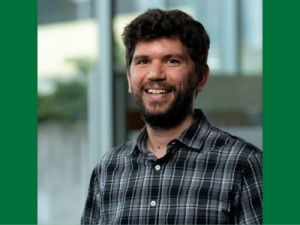
Drew Nobile
Drew Nobile is a music theorist specializing in the theory and analysis of popular music. He has served on the UO faculty since 2015 and regularly teaches courses and seminars on popular music analysis, voice in pop songs, analysis of rhythm and meter, and linear analysis, as well as courses in the first-year undergraduate theory core. Prior to his appointment at UO, Nobile served on the music faculty at the University of Chicago (2013–15) and Brooklyn College (2010–13).
Nobile’s first book, Form as Harmony in Rock Music, was published in 2020 by Oxford University Press and received the Society for Music Theory’s Emerging Scholar Award, which honors an outstanding music-theoretical book published within 10 years of the author’s PhD. The book offers a comprehensive theory of form for the “classic” rock and pop repertoire of the 1960s, ’70s, and ’80s. Fusing two central music-theoretical research areas—formal studies and popular music studies—the book demonstrates that chord progressions and formal sections sync up in specific ways, producing a small number of conventional patterns used consistently across genres and decades. In so doing, the book advocates for the value of listening to rock music structurally, arguing that a structural mode of hearing reveals essential features of the style that might otherwise remain below the conscious level.
Nobile’s current research project focuses on matters of vocal timbre and song persona in popular music of the last 30 years. The central argument is that the so-called “secondary parameters” of timbre and text play a central structural role in this repertoire, thus challenging the notion that sound and structure are fundamentally opposed. Published and forthcoming articles related to this project include “Interpreting Vocal Timbre”(Music Theory Spectrum, 2026), a systematic and accessible methodology for analyzing vocal delivery in popular songs, as well as articles on Alanis Morissette and Beyoncé. Nobile’s work on this project has been supported by the National Endowment for the Humanities, the Oregon Humanities Center, and a handful of UO grants.
In addition to his research on popular music, Nobile is active in the analysis of musical theater, especially the music of Stephen Sondheim. His chapter “Sondheim’s Dissonant Tonality,” part of the collection Here for the Hearing: Analyzing the Music in Musical Theater, received the 2025 Kurt Weill Article Prize.
Nobile has served as music theory area chair since 2022, and in fall 2025 Nobile began a three-year term as editor-in-chief of Music Theory Online, the most-read music theory journal worldwide.
Nobile is a dedicated pedagogue committed to curricular reform in the field of music theory, especially through expanding methodologies and repertoire beyond the traditional canon. In recent years, Nobile has overhauled the first-year theory core to be more inclusive, both in the identities of artists and composers and in the topics covered. In the classroom, Nobile frequently incorporates progressive, research-supported techniques, such as ungrading, universal design, and peer instruction.
- Ph.D. 2014, Music Theory, CUNY Graduate Center
- M.A. 2009, Music Theory, University of Washington
- Sc.B. 2007, Mathematics and Music, Brown University, magna cum laude with honors in music
Selected Publications
- “Interpreting Vocal Timbre.” Music Theory Spectrum 48/2 (2026).
- “Narrative Opposition in the Beatles’ Verse–Chorus Songs, 1966–67.” Intégral 36: 19–34 (2023).
- “Sondheim’s Dissonant Tonality.” In Here for the Hearing: Analyzing the Music in Musical Theater, ed. Michael Buchler and Gregory Decker. University of Michigan Press (2023).
- “Alanis Morissette’s Voices.” Music Theory Online 28/4 (2022).
- “Teleology in Verse–Prechorus–Chorus Form, 1965–2020.” Music Theory Online 28/3 (2022).
- “Double-Tonic Complexes in Rock Music.” Music Theory Spectrum 42/2 (2020).
- Form as Harmony in Rock Music. Oxford University Press, Studies in Music Theory series (2020).
- “Harmonic Function in Rock Music: A Syntactical Approach.” Journal of Music Theory 60/2 (2016).
- “Counterpoint in Rock Music: Unpacking the ‘Melodic-Harmonic Divorce.’” Music Theory Spectrum 37/2: 189–203 (Fall 2015).
- “Interval Permutations.” Music Theory Online 19/3 (Fall 2013).
- “Form and Voice Leading in Early Beatles Songs.” Music Theory Online 17/3 (Fall 2011).
Selected Honors
- Kurt Weill Article Prize, Kurt Weill Foundation for Music (2025)
- National Endowment for the Humanities Summer Stipend (2022)
- Society for Music Theory Emerging Scholar Book Award (2021)
- Adam Krims Award, SMT Popular Music Interest Group (2017)
- Oregon Humanities Center Faculty Research Fellowship (2022 & 2016)
- UO Faculty Research Award (2022 & 2017)
- CUNY Barry S. Brook Dissertation Award (2015)
- Dorothy Payne Award, Music Theory Society of the Mid-Atlantic (2012)
- Patricia Carpenter Emerging Scholar Award, Music Theory Society of New York State (2011)