
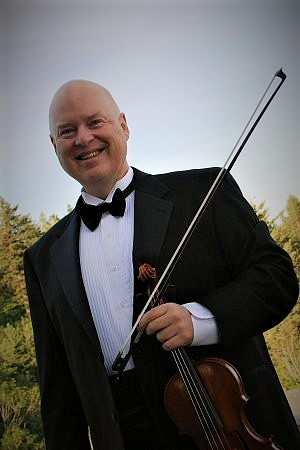
For much of his childhood, Jim McLennan was told he would never amount to much.
“Drive a truck,” his father told him. “Forget all this music stuff.”
The words landed hard. Years of discouragement followed McLennan into adulthood, shaping the way he saw himself even as he emerged as one of Oregon’s most accomplished young musicians. By the time he graduated high school, he had already achieved what most aspiring performers only dream about: performing professionally at 17, soloing with orchestras, winning statewide competitions on both violin and trombone, and marching in the Macy’s Thanksgiving Day Parade.
On paper, elite conservatories should have been waiting for him.
Instead, he chose the University of Oregon.
And in many ways, that decision saved his life.
“I could have gone literally anywhere,” McLennan recalls. “But I didn’t believe in myself.”
When he arrived at UO, he wasn’t even sure he wanted to continue in music. He briefly explored business, then psychology, searching for direction.
“I told my mom, ‘I think I need to quit school and come home. I can’t make it. I’m never going to be anything.’”
Then something unexpected happened.
A friend convinced him to walk over to the School of Music.
The moment he entered, McLennan says, everything changed.
“For some reason, everybody knew me,” he says with a laugh. “I had an instant family.”
Faculty members welcomed him. Fellow students embraced him. He joined the marching band, immersed himself in ensembles, and slowly began rebuilding the confidence that had been stripped away over years of self-doubt.
“Maybe I’m not a loser,” he remembers thinking. “Maybe I can do something.”
The transformation was swift and remarkable. McLennan earned a place in the university’s top jazz ensemble, won a prestigious jazz award, and helped lead the band to a major competition sweepstakes title. But the biggest turning point came when an old friend placed a violin back in his hands.
McLennan abandoned the instrument years earlier after being told that pursuing it was pointless. Though he had once performed at an advanced level, he had barely touched the violin since high school.
Standing in a rehearsal room at the University of Oregon, he hesitated.
“I remember thinking, ‘This is how this goes, right?’”
His friend encouraged him to audition for the string program. McLennan practiced obsessively over the summer, relearning techniques and rebuilding his skills piece by piece. When he auditioned, faculty placed him at the junior level immediately.
Soon he was winning scholarships again. Then came an audition for the Eugene Symphony, where he earned a first violin position.
Within a year, the musician who had once served as principal trombone in the university orchestra became its concertmaster on violin.
“People thought I was joking,” he says. “My friends kept asking, ‘Are you a violinist or a trombone player?’”
McLennan credits the university’s faculty for making that impossible transformation possible. Rather than focusing solely on prestige or competition, he says professors invested in him personally.
“They were more interested in me than they were interested in the program,” he says. “They wanted me to succeed.”
One conversation still stays with him decades later.
Unsure whether he had wasted too much time away from violin, McLennan approached a faculty mentor with a blunt question: Was he fooling himself?
The answer changed everything.
“No,” the professor told him. “Grab it by the horn. Don’t look back.”
McLennan did exactly that.
After completing his undergraduate studies, he continued to develop rapidly and eventually earned a scholarship to the University of Southern California. From there, his career expanded into the professional music world: symphonies, recording studios, opera pits, touring productions, and freelance work across the country.
He performed in major concert halls, including the John F. Kennedy Center for the Performing Arts, worked as a studio musician in Los Angeles, and built a career flexible enough to move between orchestral performance and jazz work. He played jingles, backed productions, and performed with elite musicians while also navigating the uncertainty that defines life for many freelancers.
“It’s an incredible career,” he says. “You meet all kinds of people. I’ve played with top musicians and top actors in the world. I’ve also played in tiny little garage-band places.”
Most recently, McLennan served as concertmaster for opera productions in Portland, including performances of The Phantom of the Opera at the Keller Auditorium.
Yet despite decades of success, McLennan admits the wounds of childhood never entirely disappear.
“It’s hard, even as an adult,” he says quietly. “I finally, at this age, started to believe in myself.”
That hard-earned perspective is part of what motivated him to establish a graduate string quartet scholarship fund at the University of Oregon. McLennan wanted to create something lasting, something impactful — something that could help students who might be carrying struggles similar to his own.
“There may be some other Jim McLennans out there,” he says. “Maybe somebody who needs that same kind of opportunity.”
His hope is that future students will find the same support system he discovered years ago in Eugene: mentors who believe in them before they fully believe in themselves.
And if McLennan has a philosophy that ties his life together, it comes from an unlikely source: Arnold Schwarzenegger.
As a college student, McLennan became fascinated not by Schwarzenegger’s fame, but by his relentlessness. One line from Schwarzenegger’s books became a personal mantra.
“‘I can’t’ should be permanently stricken from your vocabulary.”
McLennan repeated those words while practicing late into the night, sometimes until his fingers bled. He repeated them while rebuilding his technique, auditioning for orchestras, and pushing through years of doubt.
Today, he offers the same advice to young musicians.
“Believe in yourself. Follow your heart. Never give up,” he says. “Anybody can do it. Anybody can become a great musician. It depends on how you believe in yourself.”
Then he smiles, reflecting on the improbable journey from a frightened college freshman to a successful musician and philanthropist whose name will help support future generations.
“Look where I came from,” he says. “If I can do it, anybody can.”